
According to folklore, you can wish...
When blowing out your birthday candles
When Tossing a Coin into a fountain or a well
When Breaking a wishbone, and being on the receiving end of the larger half.
When you lose an eyelash, and blow it from the tip of your fingers.
When the clock strikes 11:11
When you see a falling star
Upon the first star you see at night
On a necklace clasp that has turned the wrong direction
When blowing the seeds from a dandelion in one breath
When you see a white horse
When you catch a feather
When a lady bug lands upon you
When you hold your breath in a tunnel
Am I missing any?
I'm not sure where most of these originated from, but they're the ones that I remember from my childhood. I'm not a superstitious person, but I still find some joy in wishing upon certain things...or planting the seeds of a dream.

Showing posts with label Mythology. Show all posts
Showing posts with label Mythology. Show all posts
Sonya Taaffe
Thursday, June 14, 2007 | By Cyan
At the request of a friend, I've put together a list of Sonya Taaffe works that have been published online. Since I've mentioned Sonya several times within this blog, I'm posting it here as well.
A Maid on the Shore
Crossing the Line
Niobe Aftermath
Moving Nameless
Theagenes Remembers
Over the River
Expiration
The Reliquiae
Muse
On the Blind Side
Follow Me Home
Heliotrope
The Windfalls
Green and Dying
Orpheus and Eurydice
Monday, May 28, 2007 | By Cyan
There are certain stories that resonate with me, and I'm in a mood to indulge in obsessions.
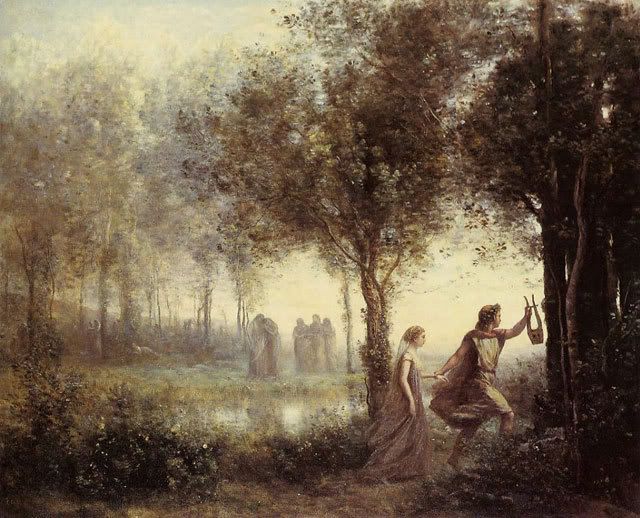
I can't remember the first time that I heard the story of Orpheus and Eurydice, but it was sometime during my childhood, later to be repeated in High School Latin classes (of which I remember very little), but the first time that it really grabbed me was when I read Shade and Shadow by Sonya Taaffe, which is a modern retelling of the story and a brilliant one at that. It's available in her collection, Singing Innocence and Experience, and I can't recommend it highly enough.
I put together a slide show of imagery related to Orpheus and/or Eurydice which can be viewed here.
The Myth
Orpheus was the son of Calliope, muse of epic poetry. While living on Parnassus, he drew the favor of the god, Apollo, who taught him to play the Lyre while his mother taught him to write verse. With such masterful teachers, Orpheus became a great musician with the striking ability to charm animals and other objects of nature, including the trees and stones. He was also an augur, foretelling the future via the patterns of birds in flight, and a patron of both Apollo and Dionysus.
Because of his skill, his presence was necessary on the journey of the Argonauts. When they passed near the Island of Sirenum Scopuli where the sirens lured sailors to their deaths with their voices, Orpheus played and sang so beautifully that he drowned out their deadly song with his own, and the sailors passed through unscathed.
Orpheus loved Eurydice with the passion of all great lovers, but like many love stories of antiquity, their romance was doomed to an early end.
One day, Eurydice was wandering with her companions, the nymphs, and a shepherd called Aristaeus made advances towards her. She fled and ran into a nest of poisonous snakes whose bite killed her instantly and carried her to the city of ghosts. Orpheus was overtaken with grief and sang songs of such sadness that all of the nymphs and the gods were driven to tears. They urged Orpheus to travel to the Underworld to appeal to Hades, and with the power of his music, Orpheus was able to soften the heart of the god of the underworld. Hades and Persephone agreed to return Eurydice to the surface under the condition that Orpheus not look back until they reached the open air.
In his anxiety, Orpheus did look back and Eurydice vanished, leaving Orpheus alone in eternal melancholy. He forsook all gods but Apollo, shunned the love of all women, and turned to the love of young boys. This angered the Thracian Maenads of Dionysus, and one morning, while he was singing and playing his lyre in a forest clearing, they attempted to murder him by casting javelins and stones. His music was so captivating that the wood and the stones would not obey, and they fell from the air before piercing Orpheus' flesh. This sent the Maenads into a wild frenzy, and they tore him to pieces, casting the ruins of his body and his Lyre into the Hebrus river where his song continued to play until his remains reached the shore of Lesbos.
There, the inhabitants buried his head and built a shrine in his honor. The remaining pieces of his body were gathered by the muses and buried at Libethra where the nightengales sing. His lyre was placed by the gods among the stars, and he was able to spend the rest of eternity with Eurydice in the city of ghosts.
About Me

A Mermaid
John William Waterhouse

Fisherman and the Siren Knut Ekwall

Andromeda
Gustave Doré